
Best AI Trip Planning In America: How Artificial Intelligence Creates Smart Travel Itineraries in Minutes
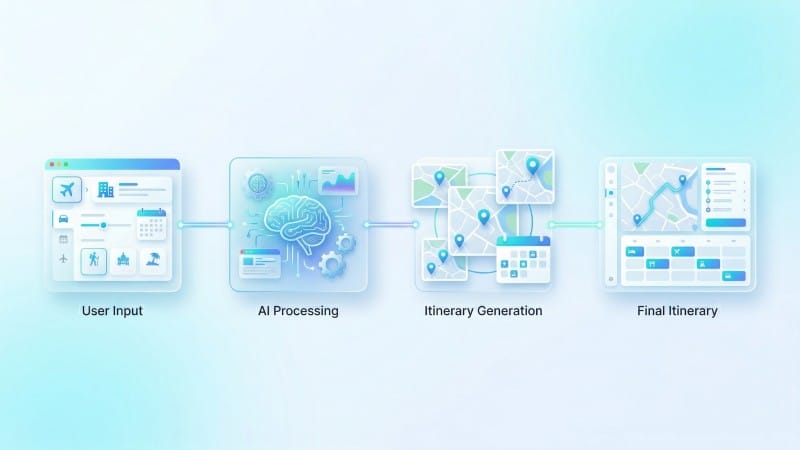
AI Trip Planning – Does it work?
The current travel industry is at a turning point. Travel companies are being forced to reconsider the way how itineraries are made due to growing customer expectations, shorter planning times, and fierce competition in the field. The old-fashioned way of manual research, supplier coordination, and frequent revisions associated with traditional planning are no longer scalable. This is where AI trip planning comes into existence.
The real question for the travel agencies, tour operators and travel businesses is straightforward although: Does AI trip planning genuinely function from a business perspective? More significantly, is it capable of providing customised itinerary quickly and accurately?
Direct Answer: Does AI Trip Planning Work?
AI trip works well for use cases involving professional travel. With just one prompt, advanced AI systems can produce highly customised itineraries with over 95% accuracy, drastically cutting down the research time, operational effort, and dependency on human expertise. AI is more of a useful revenue-generating solution rather than a novelty for B2B travel companies, as it allows for quicker turnaround times, scalable customisations, and consistent customer experiences.
Comprehending the Transition: From Manual Scheduling to AI trip planner in america
Traditionally, human knowledge, destination expertise, and in-depth research have been essential for trip planning. While this approach offers depth, it comes with its own challenges:
· It takes a lot of time to create an itinerary
· Quality is inconsistent across planners
· Personalisation at scale is difficult
· High reliance on knowledgeable employees
These gaps are seamlessly bridged with AI planning by combining extensive destination data, behaviour patterns of travellers, and real-time inputs to automate itinerary creation, without compromising on personalisation. This change in the travel industry is more about increasing operational efficiency than replacing expertise.

What is AI Trip Planning?
The use of artificial intelligence to create travel schedules automatically, based on a single prompt or a set of traveller preferences, is termed as AI trip planning.
These systems examine:
· Information on destination data (logistics, attractions, seasonality)
· Traveller preferences (spending capability, interests, past trends)
· Travel constraints (Group type, duration, accessibility)
· Historical trends and behaviours.
The result is an organised itinerary that can be shared in a matter of minutes.
Why B2B Travel Companies are Moving Towards AI Trip Planning?
1. Speed without compromising quality
Instead of hours or days, AI can provide comprehensive plans in a matter of minutes, enabling travel companies to:
· Provide faster responses to enquiries
· Cut down on turnaround time
· Enhance lead-to-conversion rates
2. Scalable customisation
· Scaling personalisation has been proved to be challenging following the traditional method. AI modifies this by enabling:
· Individual plans for each customer
· Reliable and consistent quality across several locations
· Customisation with minimal inputs.
This is particularly beneficial to agencies that handle high volumes of enquiries.
3. Reduced operational load
AI enables teams to concentrate on the following by automating research and structure:
· Customer relationships
· Negotiation with suppliers
· Curation of experiences
Instead of spending valuable time on optimising routes and looking for attractions, planners can refine and improve AI-generated itineraries.
Does AI Trip Planning Deliver Accurate Results?
A lot of people are concerned about accuracy. Initially, early AI tools produced generic, surface-level plans, however, the current AI platforms have evolved tremendously. Today’s AI trip planners get it right about 95% of the time. They gather information from local data, learn from common travel patterns and structure the trips based on realistic parameters like feasibility, distance, and what’s possible in a day.
The travel companies do not have to rework or revise the plans multiple times. They are ready to be handed-over to the customers right away.
AI vs Human Trip Planning – Realistic Comparison
What AI does best:
· Generation of itineraries instantly
· Organised and consistent structure
· Sorts through vast data sets seamlessly
· Scaling through multiple destinations
What humans do best:
· Bring in intuition and emotional intelligence
· Local flavours and storytelling
· Recommendations based on personal relationships.
It is not honestly about picking sides. The real magic happens when AI works with people, where AI handles the speed and details while humans refine the experience by adding the special touch that coding cannot.
AI Powered Trip Planning in America – Business Impact
AI is a game changer for travel planning. Each traveller gets a personalised itinerary that feels custom-made. This helps create stronger first impressions, build trust in the brand, and see more value in the offering.
With AI doing most of the heavy-listing, the teams can handle more enquiries without getting burnt out. There is consistency across planners and new hires need reduced training hours to come to speed.
In terms of revenue growth and scalability, faster responses and customised recommendations directly impact the conversion rates leading to more bookings, happier repeat customers, and higher growth without cost increase.
E-E-A-T Perspective: Why This Matters for Travel Brands
From the standpoint of experience, expertise, authority and trust, AI trip planning supports business by:
· Delivering dependable and high-quality results
· Consistent brand messaging and structure
· Reducing human error
· Providing recommendations based on data-driven insights
When combined with human expertise, AI generated itineraries, in fact, have the capability to boost brand credibility.
Is AI Trip Planning the Future of Travel Businesses?
Looking at the current requirement and resources we can easily say that AI trip planning is not just a trend, it is becoming the backbone of the industry. With rising customer expectations and shrinking time, travel companies still relying on manual infrastructure risk falling behind. AI helps companies operate smoothly, scale smarter, and deliver tailer-made plans. It is not about automaton, the real deal is providing precise, personalised experience at speed.
Final Thoughts: Does AI Trip Planning Work?
Absolutely. AI trip planning works when built for professional travel needs. For B2B travel companies, it offers a competitive edge by combining accuracy, speed, and scalability. It is evident that in the coming years the most successful businesses would be those that integrate AI and human expertise into the workflow rather than replacing it.
In an industry where experience is of utmost significance, AI breaks the barriers of time, resource, and scale. Personalisation and customisation are ensured and customers are made to feel special and catered to. Hence, AI trip planning is surely the need of the hour.