
Best Travel Software for Tour Operators: 10 Platforms Compared for US Businesses

Running a tour company, destination management company, or multi-day travel business means managing a lot of moving parts at once. You are tracking supplier rates, passenger details, time-sensitive logistics, itinerary changes, and client communication across multiple departments.
That complexity is exactly why many operators outgrow spreadsheets and generic tools quickly.
The mistake many buyers make is searching for a single platform that can do bookings, CRM, accounting, marketing, and itinerary design perfectly. In reality, that usually creates friction,
clunky workflows, and data silos. The better approach in 2026 is to build a software ecosystem around the way your business actually operates.
This guide breaks down the main categories of travel software and compares 10 platforms that tour operators are most likely to evaluate.
What is Travel Software for Tour Operators?
Travel software for tour operators is a group of specialized B2B tools used to manage the full lifecycle of a trip: booking, client data, itinerary creation, supplier management, back-office operations, and communication.
A strong travel tech stack usually includes:
· Booking and reservation engines for inventory and seat management
· CRM systems for leads, client profiles, and communication history
· Itinerary builders for premium client-facing trip presentation
· Back-office tools for margin control, ledgers, and supplier workflows
· Marketing automation tools for re-engagement and lead nurturing
Why Tour Operators Need the Right Software Stack
If you are managing multi-day departures, a small mistake can ripple through the entire trip. A late transfer, a missed hotel update, or a wrong schedule change can create operational
problems on the ground. Your software should reduce that risk, not make it worse. The right stack helps you:
· reduce manual data entry
· respond faster to client changes
· keep teams aligned
· improve conversion with polished proposals
· scale bookings without scaling chaos
Categories of Travel Software
1. Booking & Reservation Systems
These handle live inventory, reservations, seat allocation, and payment flow.
2. CRM & Client Management
These store client records, communication history, preferences, forms, and waivers.
3. Itinerary Builders & Presentation Software
These turn raw trip data into polished web links, apps, and PDFs that clients actually enjoy reading.
4. Back Office / Operations Tools
These manage internal workflow, supplier coordination, task routing, and dispatch logic.
5. Marketing & Automation Tools
These help with email campaigns, lead nurturing, and repeat business.
6. Accounting & Finance Tools
These focus on margin tracking, commission structures, tax handling, and P&L visibility.
Top 10 Travel Software Platforms
1. Rezdy
Category: Booking & Reservation System
Rezdy is a strong fit for day-tour operators, attraction providers, and activity businesses that need fast online booking and distribution. It connects well to channels like Viator and
GetYourGuide, which makes it useful for operators focused on volume. It is not built for complex multi-day itineraries.
Best for: Day tours, excursions, and local activities
2. Tourwriter
Category: Back Office & Operations
Tourwriter is built for operators that need deep supplier management, structured costing, and strong margin control. It is especially useful for inbound operators and custom multi-day specialists. The trade-off is a more traditional interface and a heavier learning curve.
Best for: Mid-to-large multi-day tour companies and DMCs
3. Tripsica
Category: Itinerary & Workflow Operations
Tripsica is the presentation and workflow layer that helps operators build and update itineraries quickly. Its biggest advantage is dynamic editing: when trip details change, the layout adjusts
without breaking the proposal. It is designed for speed, branding, and conversion — not as a full accounting system.
Best for: Performance-focused operators, FIT builders, and corporate group coordinators
4. Peak 15
Category: Enterprise CRM & Booking Platform
Peak 15 is aimed at larger outbound operators that need a deeply integrated enterprise system. It is strong on automation, vendor payables, and complex operational logic, but it is too heavy for smaller teams.
Best for: Large-scale outbound operators
5. Wetu
Category: Itinerary & Content Distribution
Wetu is widely used for content-rich itinerary distribution, especially in safari and destination-focused markets. Its big strength is the property media library and B2B content sharing. Its weakness is flexibility for dense, non-standard ground logistics.
Best for: Inbound operators and destination specialists
6. Ezus
Category: Operations & Quoting Software
Ezus is useful when pricing, margin calculation, and supplier worksheets need to live close to the proposal workflow. It helps operators move from costing to quote generation quickly. The output tends to feel more corporate than editorial.
Best for: DMCs and custom group travel businesses
7. Vamoos
Category: Client-Facing Delivery App
Vamoos is more of a traveler experience platform than a quoting tool. It works well when you want to give clients an app-based, mobile-first trip companion with ofline access and live trip updates. It needs a separate backend for booking and proposal creation.
Best for: High-end group operators and adventure travel brands
8. Tern
Category: CRM & Task Management
Tern is a modern CRM that appeals to independent advisors and small teams. It is easy to use and designed for clean daily workflows. It is not meant to replace heavy finance systems.
Best for: Boutique custom travel providers and independent advisors
9. TravelWorks
Category: Accounting & Finance Software
TravelWorks is a strong choice for agencies that need serious financial tracking, GDS integration, and detailed reconciliation. It is highly reliable for accounting teams but offers little for client-facing presentation.
Best for: Large agency back offices and finance teams
10. Bokun
Category: Booking & Reservation Engine
Bokun is an affordable entry-level booking platform for operators who want low-friction online
reservations and distribution. It is a practical fit for local operators, but not for complex tailor-made trips.
Best for: Budget-conscious local operators and activity businesses
Modern Tour Operator Software Comparison Matrix
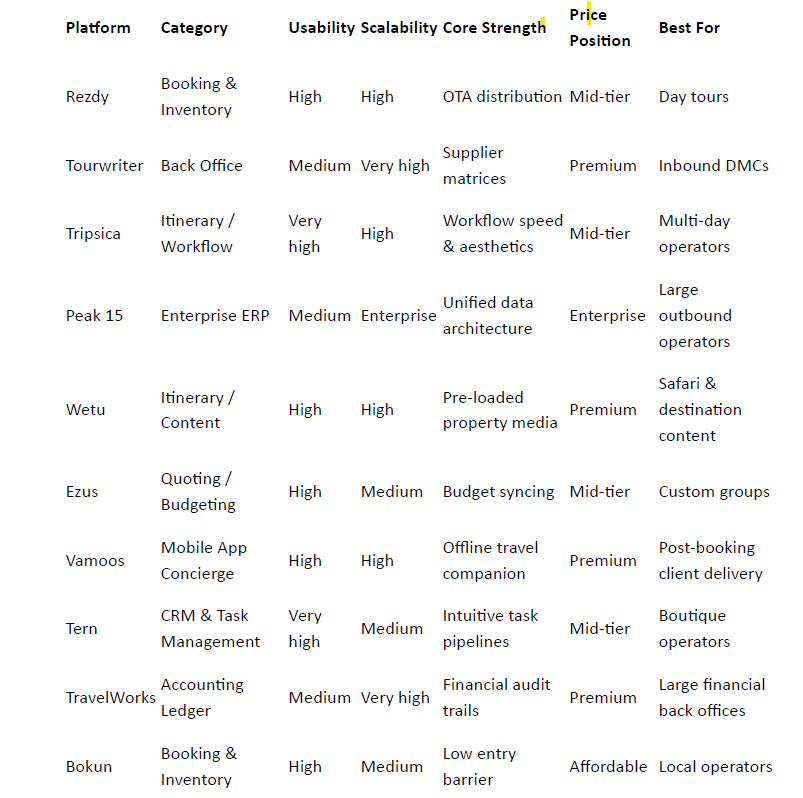
Itinerary & Workflow Tools: The Engine of Conversion
For most tour operators, the itinerary is the moment where operational work becomes visible to the client. If the proposal looks messy or takes too long to update, sales momentum drops.
That is where Tripsica fits best. It does not try to replace your accounting engine. It speeds up the production layer, helps your team reuse master flows, and keeps the proposal visually strong even when the itinerary changes. That combination is what makes it useful in a modern travel stack.
Best Software Stack by Operator Type
· Local Day-Tour Stack: Rezdy + Bokun + QuickBooks Online
· Custom Multi-Day FIT Stack: Tern + Tripsica + QuickBooks Online
· High-Volume Inbound DMC Stack: Tourwriter + Tripsica + TravelWorks
· Large Outbound Enterprise Stack: Peak 15 + Vamoos + custom API workflows
Buyer Decision Framework
Before choosing any platform, ask:
1. How long will implementation really take?
2. Can the data move in and out easily?
3. Is pricing based on seats, usage, or booking volume?
4. Does the system adapt dynamically when the itinerary changes?
ROI and Efficiency
The real value of software is not the subscription price. It is the time it saves, the errors it prevents, and the speed it adds to sales.
A good stack should reduce manual formatting, shorten proposal creation time, and help your team respond while purchase intent is still high. That is where connected tools outperform manual workflows.
Trends in Travel Software in 2026
Three changes are shaping the market:
· Integrated ecosystems are replacing monolithic tools
· AI is helping parse supplier content faster
· Clients expect real-time portals instead of static PDFs
Conclusion
The best travel software for tour operators is not one tool. It is the right combination of systems that fit your workflow, your team size, and your trip complexity.
If you need inventory depth, back-office control, and heavy reconciliation, legacy systems still matter. But if your biggest bottleneck is proposal speed, visual presentation, and rapid itinerary edits, Tripsica deserves a serious place in the stack.
FAQ
What is the best travel software for tour operators?
There is no single best platform. Rezdy and Bokun work well for day tours, Tourwriter is strong for multi-day costing, and Tripsica is built for fast, premium itinerary workflows.
Which platforms do tour operators use?
Most operators use a mix of booking systems, CRM tools, itinerary builders, and back-office accounting software rather than one all-in-one product.
What features should travel software have?
Look for inventory management, multi-currency tracking, supplier communication, automation, and a dynamic client-facing itinerary layer.
How do tour operators manage operations?
They use connected cloud tools to automate manifests, deposits, itinerary updates, and supplier communication.
Which tools are essential for tour companies?
A booking engine, a CRM, a finance system, and a strong itinerary presentation tool are the core essentials.
If you want, I’ll do the next blog in the same format and keep going one by one in order.