How AI is Helping Travel Agents

The travel industry has always been driven by expertise. Top agents know the best destinations, understand what motivates travellers, and can craft an itinerary that is more than a checklist; it is a memorable experience but things are evolving quickly. By 2026 travellers expect highly personalised and they want the answers immediately.
A traditional itinerary planning approach typically entails hours of research, sorting through hotels, planning routes, comparing attractions, and making sure everything fits together. When requests start stacking up, this method just cannot keep pace. That is where Artificial Intelligence (AI) comes in and transforms the travel agent's workflow.
Direct Answer: How AI Is Helping Travel Agents
AI is not just a trendy term here. It is a practical tool making a tangible impact. Agents can now deliver personalized itineraries in minutes instead of hours. AI takes into consideration traveller preferences, searches destination data, and learns from travel trends to generate day-by-day plans with over 95% accuracy. This allows the travel agencies to respond faster, personalize more, and dedicate more time to building client relationships instead of spending time in manual research.
Why Travel Agents Need AI Today
Travel expectations have evolved dramatically. Modern travellers expect:
- Customized recommendations
- Faster responses
- Flexible and unique plans
- Digital-first planning experiences
For the agents handling multiple enquiries, managing all this manually becomes extremely difficult.
AI travel tools bridge the gap by automating time-consuming research while maintaining personalization.
Where AI has the greatest impact:
- Faster itinerary creation
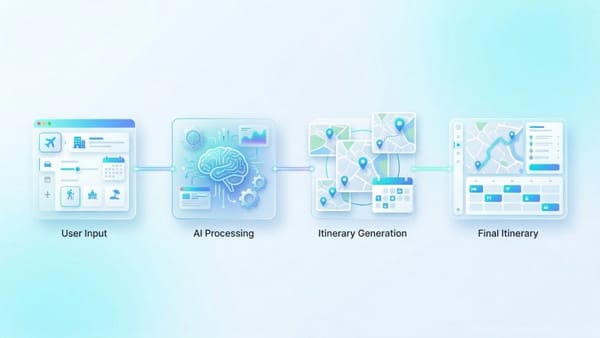
One of the biggest advantages of AI in travel planning is speed. With AI agents do not have to spend hours structuring day-wise plans. They simply enter the essentials, such as:
- Destination
- Duration of stay
- Budget range
- Traveller interests
- Group type (family, couple, solo or corporate)
Once the details are in place, AI does the rest, creating a structured itinerary in just minutes. Agents can fine-tune the details but the bulk of the work is already complete.

Benefits for travel agents include:
- Quicker proposal turnaround
- Ability to handle more client enquiries
- Less time wasted on redundant research
- Reduced operational workload
That is the way to grow a travel business in today's world.
2. Highly personalized travel experiences.
Nowadays personalization is central to how people plan their travels. The travellers want trips that reflect their real interests not just a standard tour. This is where AI makes a big impact. Travel agents use AI to achieve this by analysing multiple data points such as:
- Traveller behaviour patterns
- Popular attractions and experiences
- Seasonal travel trends
- Activity preferences
With all this data they are enabled to build trips tailored to each person, moving away from generic one-size-fits-all packages.
Examples include:
- Itinerary for food lovers focused on local specialties
- A week full of outdoor adventures
- A journey exploring a region's history and culture
- Slow-paced luxurious getaway
AI allows agents to create such unique trips for travellers at scale, so everyone enjoys a truly personalized experience.
3. Improved accuracy in travel planning.
Planning trips manually leaves plenty of room for mistakes. It is easy to end up with inconvenient schedules or illogical routes. AI changes that. AI travel planning systems improve accuracy by considering:
- Travel time between attractions
- Optimal routing between destinations
- Feasible activity combinations
- Workable schedule
Modern AI itinerary generators reach over 95% accuracy so agents spend less time over revisions and travellers start with better trips.
For travel companies this means:
· More reliable proposals
· Fewer last-minute itinerary corrections
· Better customer satisfaction and confidence.
4. Boosting Productivity for Travel Agencies
AI does not replace travel agents; it empowers them. By automating repetitive tasks like itinerary creation or destination research, AI allows travel professionals to focus on higher-value activities that truly drive business, including:
- Engaging and building strong client relationships
- Higher conversion rates
- Securing better deals with suppliers
- Designing curated travel experiences
- Growing agency’s customer base.
As a result, agencies can scale operations into new destinations and markets, without expanding teams proportionally.
5. Consistency in itinerary quality.
With multiple planners on a team, each person brings a unique approach depending on individual expertise. This can lead to inconsistency. AI travel planning tools address this by establishing a unified standard by:
· Standardizing itinerary formats
· Ensuring balanced day-wise schedules
· Structuring activities logically.
This consistency allows the clients to experience a credible and dependable brand every time. That is the foundation for building trust and a reputation for professionalism.
AI and Human Expertise: The Perfect Combination
AI offers speed and efficiency but nothing matches genuine human expertise when it comes to creating an amazing trip. Travel agents provide elements that algorithms cannot, such as:
- Local insights and cultural understanding
- Personal recommendations
- Emotional intelligence and customer interactions
- Problem solving during travel disruptions
The most effective model is a hybrid approach, where AI handles the research, sorting, and grunt work while the agents refine the itinerary, adding that personal touch and experience that cannot be automated.
This combination ensures that travellers enjoy the best of both worlds: fast efficient planning paired with true insight and authenticity.
Common Concerns about AI in travel planning
Despite all its advantages many travel professionals hesitate to fully embrace AI. The main concerns include:
- Loss of personal touch
- Over reliance on automation
- Questioning of data accuracy
However, when used properly AI enhances rather than replaces human expertise. Agents still design the trips and make the decisions. AI just gives them better tools and lets them focus on what matters most.
The Future of AI in Travel Planning
AI adoption in the travel industry is accelerating rapidly. In the coming years AI-powered tools will likely proliferate into domains such as:
- Real-time itinerary adjustments
- Dynamic travel recommendations
- Predictive travel insights
- Smart customer behaviour analysis
In order to remain competitive, travel agencies and tour operators will need to incorporate AI into their workflow.
Conclusion
AI is fundamentally transforming how travel agents operate and deliver travel experiences. By cutting down on tedious research and improving accuracy, AI helps agencies respond faster, personalise trips and work more efficiently.
For travel companies looking to thrive in a competitive market, AI does not replace expertise; it rather amplifies it. The agencies that embrace AI today will be the ones delivering the personalized, high-quality travel experiences that modern travellers expect.